Solo Exhibition 2026
Synopsis
This essay examines how the “Listening to Trees” series relates to abstraction, Jackson Pollock’s paintings and landscape painting, while highlighting shared kinetic energies, notions of new worlds, and differences in process and intention. It also situates the work within Australia’s plein-air landscape tradition, noting how Cleveringa builds upon yet significantly diverges from that history, playing upon it across varying temporalities.
Abstraction in painting refers to the entry into new worlds through the use of visual elements such as line, colour, shape, texture and rhythm for their own expressive potential rather than for the depiction of recognisable objects or scenes. While representational art seeks to mirror the visible world, abstraction distils experience, emotion or ideas into formal relationships. These can evoke sensations directly or open spaces for interpretation. Historically, abstraction gained prominence in the early twentieth century as artists responded to modernity, photography’s challenge to representation, and new philosophical ideas. Kandinsky sought spiritual resonance through colour and form; Mondrian pursued universal harmony via geometry. Later, Abstract Expressionists such as Pollock emphasised gesture and the unconscious.
Abstraction is not a single style but a spectrum ranging from geometric purity to gestural energy. It allows artists to explore perception, time and embodiment, as well as potentially undiscovered realms. Philosophically, abstraction facilitates an entry point into different worlds of thought, aesthetics, beauty and perspective.
Phenomenologists such as Merleau-Ponty describe painting as revealing the structures of lived experience or the invisible threads connecting body, world and vision. Abstract works often heighten awareness of the painting as an event or field of forces rather than a window onto the world. They can feel like visual music, or diagrams of energy and process.
Cleveringa’s abstraction emerges from a hybrid process that is both site-responsive and interventional. He neither invents forms in isolation nor strictly observes a motif. Instead, he collaborates with environmental kinetics. Branches sway in the wind and guide dripping paint and splatter; the artist himself also intervenes and they collaborate creating organic, time-based gestures recorded on prepared or recycled surfaces. Saline bags filled with paint tied to the site’s branches, together with movements of passers-by forces and “missiles” from flora and fauna, enter the space. Sometimes tree sap, leaves and accidental humus become physically embedded in the work. The action intentionally incorporates the interconnectedness, history and culture of the site through a postmodern lens. The subsequent cutting and reassembly introduce order, fragmentation and new rhythms. The resulting works feel both natural and constructed. Gestural passages retain the fluidity of wind and gravity, while tessellated arrangements suggest pixel grids or mapped data like the matrix behind all things whilst also nodding to a digital mediation of nature and/or a perspective of the contemporary period of mobile phones and artificial intelligence. Abstraction here is indexical: it bears traces of real forces, yet remains interpretive. It does not reject representation entirely but abstracts the experience of landscape interaction. The series engages the aesthetics of process. The artwork records performance (outdoor collaboration) and reflection (on-site and studio disruption). This aligns with process-art traditions while adding ecological specificity. Viewers sense duration: marks are sometimes made over hours, sometimes over weeks, especially in ink drawings that utilise wind variations and intervention. Such works can prompt reflection on ‘human or site agency’. In an era of climate concern, this abstraction becomes a quiet prompt for mindfulness. That is, to listen, collaborate, and then consider the consequences of reshaping.
Paradoxically, despite aspects of process art, another viewer may perceive the artworks as ultra realism in the sense that the painting marks made by the environment (or site) are direct and ‘as real as it gets’ by nature’s hand.
Cleveringa has referenced influences such as Paul Feyerabend’s epistemological anarchism, which advocates openness to multiple paths of understanding and supports his experimental, non-dogmatic approach. There is no single “correct” way to engage nature or art; the series embodies a lush plurality of possibilities. Compared with pure geometric abstraction, Cleveringa’s work is warmer and more organic. Compared with purely gestural abstraction, it adds deliberate construction and doubt. It thus occupies a contemporary middle ground: rooted in material reality yet open to metaphor and reflection. This makes the series accessible while rewarding sustained attention. The modest scale of many pieces such as drawings and smaller assemblages, contrasts with monumental abstractions and invites intimate dialogue. Larger assemblages, such as “Stroud” (360 x 122cm) or “Eden” (720 x 120cm), or sections of “Sway” (91.5 x 183cm) offer immersive fields.
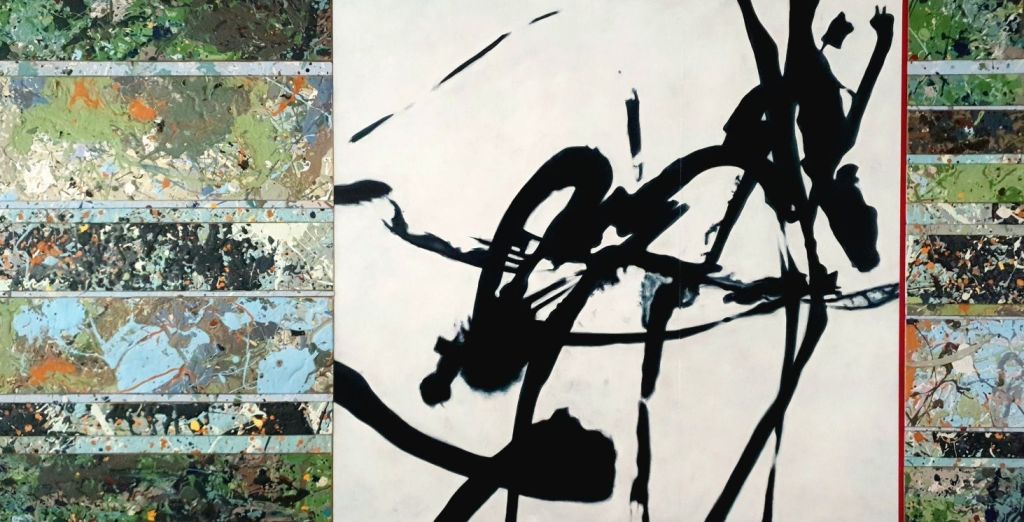
“Sway”
Synthetic polymer, oil, leaves, on wood, painting assemblage
91.5 x 183 x 4cm
Jackson Pollock’s drip and pour paintings of the late 1940s to early 1950s represent a landmark in gestural abstraction. Working on canvas laid flat on the studio floor, Pollock moved around the work, pouring household enamel paint from sticks or cans. The results are dense webs of continuous lines, splatters and pools, with no traditional composition or focal point. Harold Rosenberg termed this “action painting,” emphasising the canvas as an arena for existential gesture. Similarities with Cleveringa are evident in kinetics and horizontality. Both artists relinquish some control to physical forces. Pollock harnessed gravity, momentum and paint viscosity; Cleveringa incorporates all of that plus wind, branch movement and gravity in outdoor settings by collaborating, dropping and splattering paints with the tree/site as artist. Both treat the support as a terrain rather than a vertical picture plane. Cleveringa further posits the intelligence of the environment as a system developed over billions of years, in the context of the Anthropocene, where the tree represents only one figure within a larger ecology of interconnectedness. (*Timothy Morton’s writings about site or ecological space as an entity, itself, come into play here as well as a further added perspective should the reader wish to pursue it).
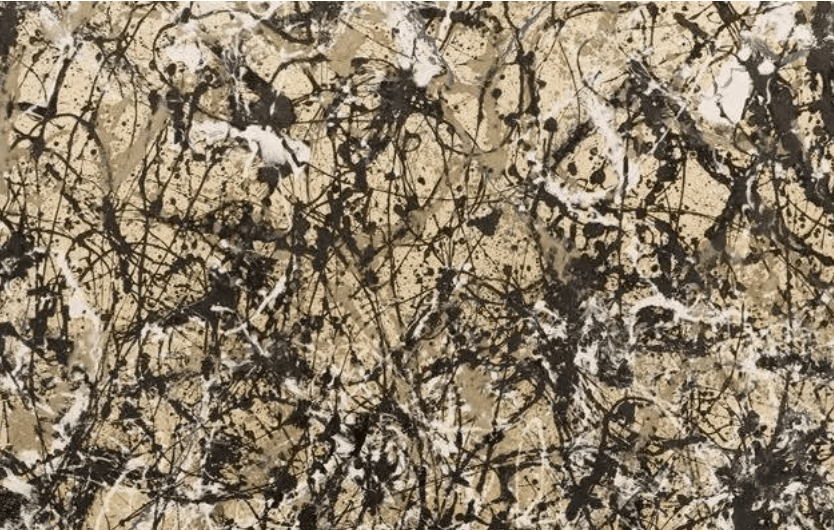
Pollock’s “Autumn Rhythm (Number 30)” (1950) features rhythmic black lines looping and intersecting across a vast horizontal field, evoking natural complexity, perhaps tangled undergrowth or cosmic energy. Scientific analysis has shown these patterns to be fractal, with self-similar structures at different scales that mirror coastlines, trees or rivers. Fractal dimensions increased as Pollock refined his technique in mature works; he built complexity iteratively, with localised marks joined by longer trajectories. Cleveringa’s outdoor phase similarly captures organic gesture. In drawings such as “Currumbin- A Zestful Sun” (2022), ink and ironbark sap respond to wind from a pandanus tree beside the beach, producing varied dots, lines and densities that record temporal shifts. Stronger gusts create bolder marks, analogous to different intakes of breath. Larger works such as “Stroud- Horizon Line” (2020) or “Eden” (2021) translate these into painted plywood. Especially in “Sway” (2026) where parallel horizontal stripes represent different places, spaces, times and meditations incorporating mark-making gestures, fractals and kinetic forces of the environment looking like textured landscapes or topographical maps from a view point above hovering over the forests and landscape’s they were created in, such as, Namadgi, Booti Booti, or Kosciusko National Parks, as well as Wagga Wagga’s Wiradjuri Reserve etc.
The marks feel alive, thick and slowly moving with gravity on the ground- indexical of environmental energy. They are further disrupted in the artwork by a difference and contrast in colour, medium, texture and style of the assembled, scaled up oil painting that demonstrates a truthful, microcosm of the environment’s energy looking like language or calligraphy (originally a drawing by a site- ink and paper) but enlarged and rendered in oil paint by Cleveringa.
Key differences emerge in agency and completion. Pollock’s gestures were primarily his own, channelled through tools and physics within the controlled studio. He denied pure accident, maintaining intentionality. Cleveringa explicitly shares authorship with trees and wind, describing a “collaborative visual dialogue” in which the environment “speaks.” Pollock refined within one evolving field; Cleveringa disrupts by cutting the collaborative marks and reassembling fragments into something new. This second phase introduces fragmentation, new structure, and new possibilities. In “Eden, Listening to Trees” (2021), initial performance marks were cut and reordered for an outdoor exhibition among living trees, creating a layered conversation between artefact and site. Pollock’s fractals feel continuous and immersive, evoking unity with nature (“I am nature”). Cleveringa’s reassembled works introduce discontinuity, symbolising human reorganisation of the natural. This adds an ecological critique: we listen, then reshape, often disruptively. Sometimes we do not listen to what the environment is saying. His tessellations also evoke digital culture’s pixelated view of the world, contrasting with Pollock’s analogue fluidity but also demonstrating the ‘holding’ of multiple perspectives and a way forward towards a future world view. Both artists achieve “all-over” energy, yet Cleveringa’s process is slower and more dialogic, involving outdoor waiting, meditation, and listening rather than Pollock’s dynamic studio dance. The environment is both meditating and dancing with Cleveringa. The wind and trees dance; the site or space is personified as a living, breathing actor. Pollock’s scale is often monumental, while Cleveringa’s ranges from intimate drawings to larger panels. Where Pollock channelled the personal unconscious, Cleveringa emphasises relational ecology, or both, in collaboration as a site entity. These comparisons highlight evolution and continuation. Cleveringa extends action painting’s kinetic freedom into environmental co-creation and conceptual intervention, rendering it relevant to twenty-first-century concerns with the science, culture and politics of climate change, while also drawing the schema of capitalism inward. His work retains gestural vitality while adding layers of reflection and responsibility.
Parochially, Australia’s plein-air tradition, crystallised in the Heidelberg School of the 1880s-1890s, involved painting outdoors to capture local light, colour and atmosphere with a sense of realism. Artists such as Tom Roberts, Arthur Streeton, Frederick McCubbin and Charles Conder established camps near Melbourne and Sydney. Influenced by French Impressionism and Barbizon realism, they sought a distinctly Australian vision of golden paddocks, bush interiors and vibrant eucalyptus light, employing loose brushwork and direct observation. This practice shifted Australian art from studio idealisation or European mimicry toward authentic engagement with place. Works such as Streeton’s sun-drenched landscapes helped shape national identity around Federation. Later artists continued plein-air approaches, adapting them to modernism. Cleveringa shares the commitment to working outdoors and responding to Australian landscapes, particularly bush environments. He visits national parks, reserves and sites (Namadgi ACT, Booti Booti NSW, Wiradjuri Reserve NSW, Currumbin Beach QLD), engaging directly with trees, light and space. Like the Heidelberg painters, he values the specificity of place; the use of local or historically resonant materials such as sap, leaves which ties the work materially to the site and the experience including video, meditation and memory of place and space.
Divergences, however, are profound. Heidelberg artists observed and represented visual appearances like atmospheric effects, tonal values, momentary light. Their goal was often pictorial and figurative, conveying the feeling of being in the landscape through recognisable (if loosely rendered) scenes. Cleveringa abstracts the interaction itself. He does not paint what trees look like but records how they move and communicate through marks, extending conversations about the environment, climate change, the Wood Wide Web and the Anthropocene. In addition, ironically, back in the studio, the plein air landscape process painting is sometimes assembled to create another form of tessellated landscape painting. So, this can become reflectively and aesthetically, purposely complicated. Traditional plein air is primarily observational and authorial: the artist’s eye and hand interpret the motif. Cleveringa’s practice is collaborative and performative, yet still authorial. Trees are co-creators. The wind’s agency introduces unpredictability and temporality beyond what a static observer captures, unless, of course, we understand our reality’s fluid dynamics as a fractal language which is yet to be fully known. This extends plein air painting from representation to participation. The studio intervention further differentiates the practice while retaining its core authenticity. Heidelberg works aimed for fidelity to the observed moment, even if finished indoors, which did occur- and so does Cleveringa in varied ways. His cutting and reassembly introduce construction and metaphor, transforming raw collaboration into reflective artefact. This builds on assemblage traditions while grounding them in landscape experience.
Cleveringa’s practice thus honours plein air’s directness and love of place while updating it for the contemporary moment. In an age of ecological crisis, simply depicting beauty is partly sufficient; active listening and acknowledgement of disruption feel necessary. His work retains humility whilst using modest and recycled materials and site-specificity, as well, while achieving conceptual depth. It connects to broader Australian concerns with land, environment and identity, extending the tradition rather than rejecting it. Extra context enriches this reading. Indigenous Australian cultures have long listened to Country in profound ways. While Cleveringa’s practice is contemporary and non-Indigenous, it resonates with themes of attentiveness. Scientific interest in tree communication (mycorrhizal networks, the “wood wide web”) parallels his kinetic listening, adding layers without claiming equivalence.
Cleveringa’s process of site selection, material preparation, outdoor collaboration, studio reassembly creates a uniqueness to abstract work. Texture arises from drips, cuts and overlaps of gesture. This hybridity bridges drawing, painting, sculpture and performance. It differs from pure plein air or studio abstraction by embedding multiple temporalities such as the environment’s time scale, performance time, reflective time, drying time and adjunct studio time. The disruption phase adds an ethical dimension, acknowledging interference while seeking new harmony. Aesthetically, the works succeed through balanced tension, organic flow versus geometric order or symbolism, chance versus choice. They reward viewing at different distances and physical perspectives: gestural details up close and an overall “big-picture” rhythm from afar. Perception itself has varying temporalities, if the viewer can reach them and enter these worlds. The modest scale of many pieces encourages personal engagement. Broader significance lies in gentle advocacy within the Anthropocene era.
The series contributes to cultural dialogue on climate without slogans about our ongoing relationship to the world we need or want to have. It is artistic climate action. The work, process, story and outcomes intentionally activates the viewer. The final outcome functioning as an artefact and, perhaps, in the future becoming nostalgic reference to a past period named the Anthropocene should we hopefully be able to navigate climate change successfully. “Listening to Trees” quietly enriches abstract painting by fusing plein-air directness, action gesture and conceptual assembly. It offers a humble yet significant model for art that listens before speaking.
Bibliography
1. “Listening to Trees series: A Dialogue… (2025)” https://jancleveringa.com/selected-writings-conversations-insights/listening-to-trees-series-a-dialogue-with-nature-and-sustainability/
2. Art Atrium Gallery. “Jan Cleveringa.” https://artatrium.com.au/jan-cleveringa.
https://artatrium.com.au/48-current-exhibition-1/jan-cleveringa-disrupted-dialogues
3. Merleau-Ponty, M 1964, “Eye and Mind”, trans. C Dallery, in JM Edie (ed.), “The primacy of perception and other essays on phenomenological psychology, the philosophy of art, history and politics”, Northwestern University Press, Evanston, IL, pp. 159–190.
http://www.biolinguagem.com/ling_cog_cult/merleauponty_1964_eyeandmind.pdf
4. Taylor, RP, Micolich, AP & Jonas, D 1999, “Fractal analysis of Pollock’s drip paintings”, Nature, vol. 399, no. 6735, p. 422. https://www.nature.com/articles/20833
5. Taylor, RP 2002, “Order in Pollock’s chaos”, Scientific American, vol. 287, no. 6, pp. 116–121. https://www.scientificamerican.com/article/order-in-pollocks-chaos/
6. The Heidelberg School / Australian Impressionism: Art Gallery of NSW, NGV publications.
Lane, T 2007, Australian Impressionism, National Gallery of Victoria, Melbourne.
The authoritative NGV exhibition catalogue (accompanying the 2007 survey at the Ian Potter Centre: NGV Australia). Exhibition page (official NGV record)
https://www.ngv.vic.gov.au/exhibition/australian-impressionism
7. Varnedoe, K with Karmel, P 1998, Jackson Pollock, Museum of Modern Art, New York (distributed by Harry N. Abrams). https://www.moma.org/calendar/exhibitions/226

