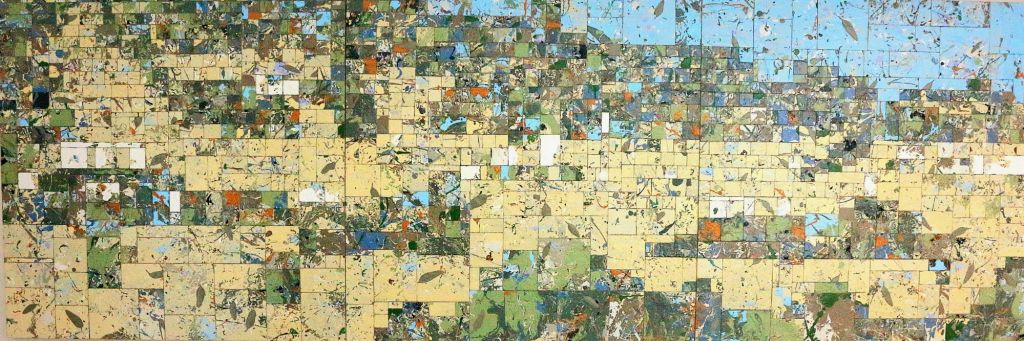
In a world increasingly shaped by digital screens and rapid urbanisation, the call to reconnect with nature has never been more urgent. Jan Cleveringa, a Sydney based contemporary multidisciplinary artist, responds to this call through his innovative Listening to Trees series, particularly his work Eden, Listening to Trees. This series, encompassing paintings, drawings, and sculptures, invites viewers to engage in a philosophical dialogue with the natural world, emphasising coexistence, mindfulness, and sustainability. By using the kinetic energy of trees and the environment as a personified entity, Cleveringa creates a unique artistic process that metaphorically disrupts collaborative conversations (gestural mark-making communications) with the environment, reflecting humanity’s complex relationship with nature.
This essay explores the philosophical and aesthetic depth of Cleveringa’s Listening to Trees series, with a focus on his Eden, Listening to Trees artwork, and briefly also addresses his The Corporate Snake installation. It also examines the Eden painting assemblage metaphor of tessellated or pixelated forms in the context of the digital age, portraying connections to how contemporary technology shapes our perception of nature, ourselves and contemporary society.
The Listening to Trees Series: A Collaborative Dance with Nature
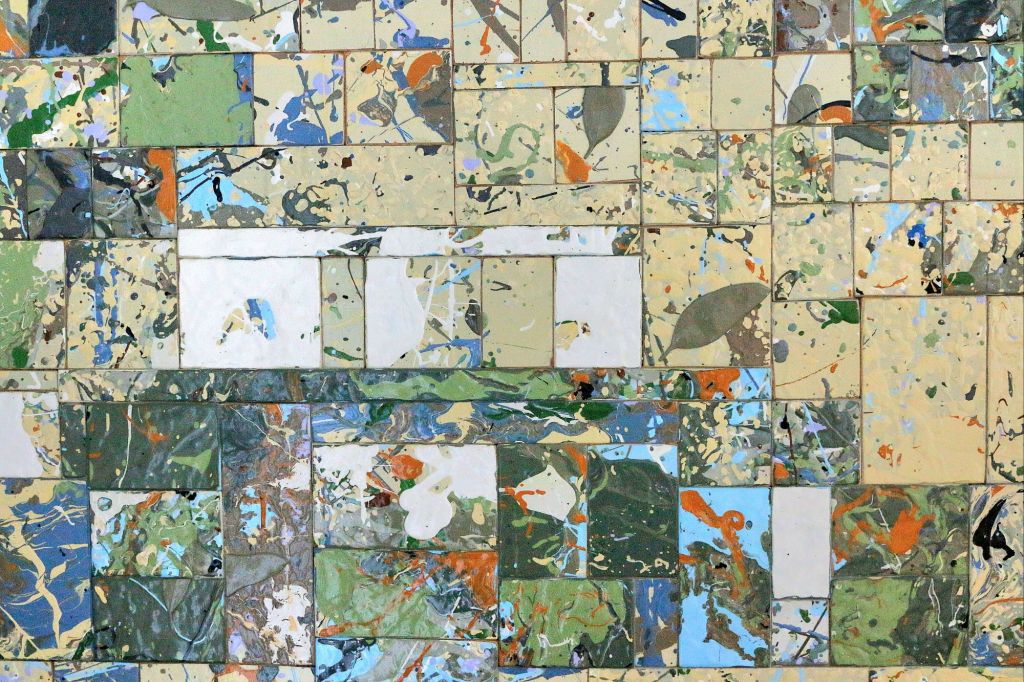
The Listening to Trees series is a multidisciplinary exploration of humanity’s interconnectedness with the natural world. Unlike traditional art practices where the artist exerts full control, Cleveringa’s process involves collaboration with the environment itself. He allows the kinetic energy of trees, swayed by wind, gravity, and natural rhythms, to create initial marks on canvas, paper, or wood. These marks, made with materials like ink, watercolour, dripping paint and discarded gumtree sap, capture the organic gestures and patterns of the environment. Once collaborated and finished at a specific site- environment, he sometimes later then intervenes in the studio, cutting and reorganising these natural patterns into abstract, tessellated forms, creating new artworks that reflect the irony of reshaped landscapes which the landscape collaboratively made. This becomes a metaphor for humanity’s habit of altering nature to serve its own purposes.
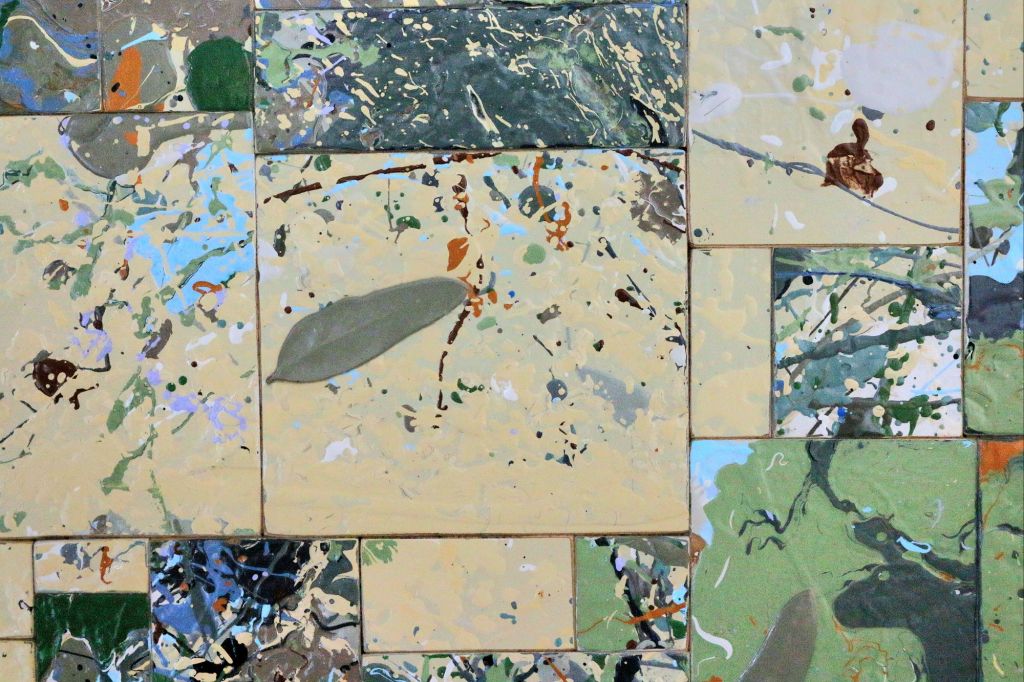
This process of disruption and reorganisation is central to the series’ uniqueness. The initial marks represent a direct, unfiltered communication between the artist and nature, personifying the environment as an active participant. Other ideas such as ‘The Matrix,’ ‘Fractals’ and the ‘Fibonacci sequence’ may also be involved in the gestures. That is, the mystery of mathematics and any alternative realities that may shape our world. Hence, encouraging a deeper perspective into the potential of the artwork. By cutting and reassembling these patterns, Cleveringa symbolises the human impulse to impose order on the natural world, often at the cost of its inherent harmony. He is not following the natural flow. This act of disruption mirrors broader societal patterns, such as deforestation, urbanisation, and resource exploitation, while inviting viewers to reflect on their role in this dynamic. The artist is mindful of various perspectives.
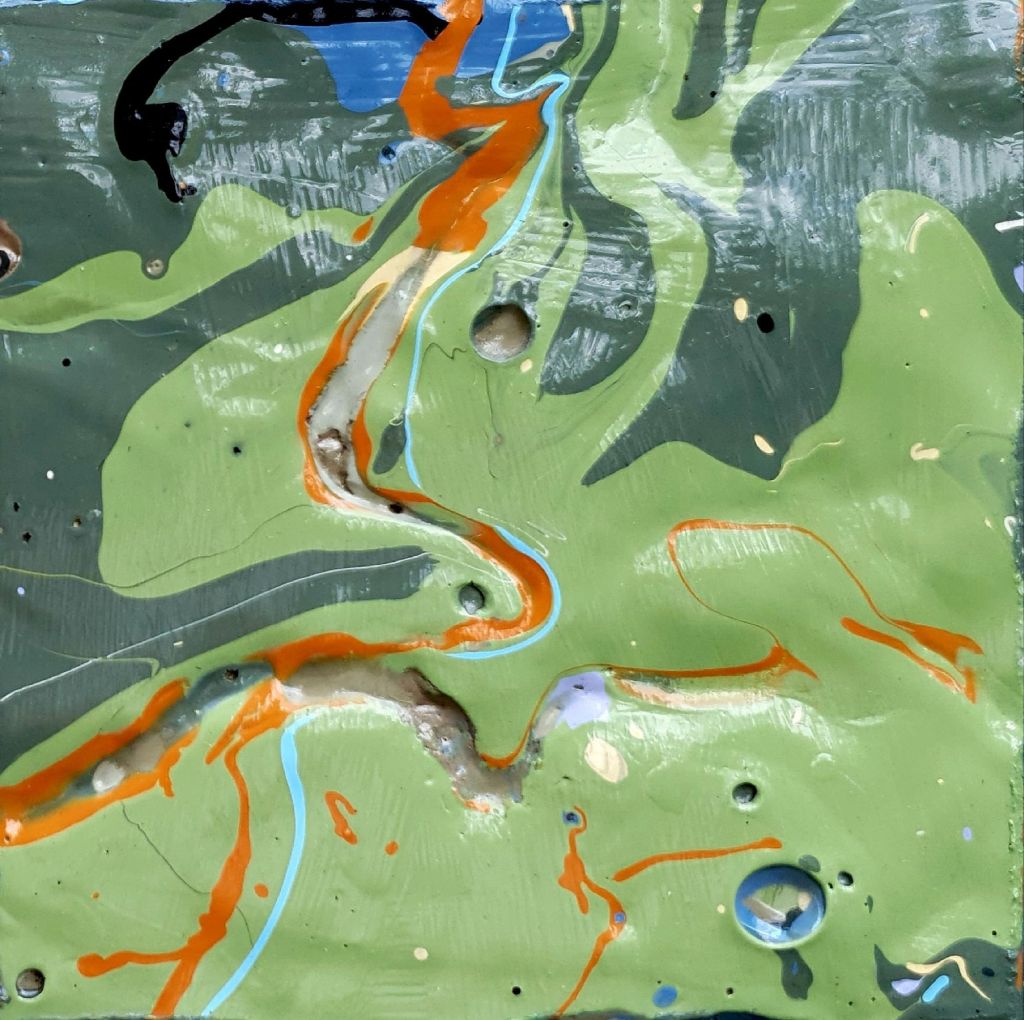
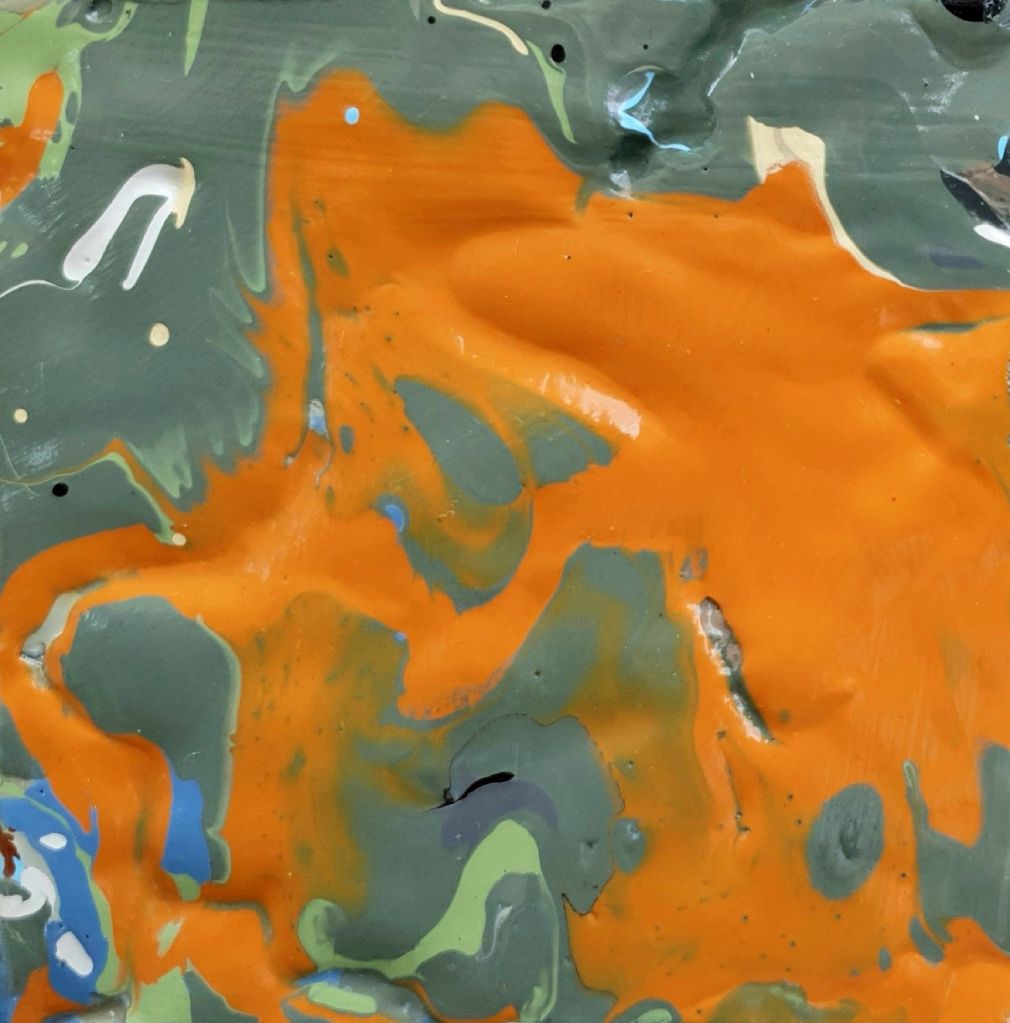
Furthermore, it’s worth mentioning that Fractals are patterns that repeat at different scales, like tree branches and mountains. The Fibonacci sequence (0, 1, 1, 2, 3, 5…) appears in nature’s spirals, such as sunflowers, pinecones and galaxies. Paint dripping in wind can create fractal-like shapes, perhaps, mirroring these natural patterns that exist. There could be a language in the gestures that we don’t comprehend yet like hieroglyphics or musical notes to the uneducated. Cleveringa’s art, using recycled materials, mirrors these patterns as the trees’ movements create abstract, fractal-like forms on canvas. The artist invites the viewer to ponder about the enigmatic, mathematical beauty, at a completely other level, woven into the environment and/or our reality, let alone a contemporary digital and Anthropocene view of the world.
https://edengardens.com.au/blogs/artist-profile/jan-cleveringa

Eden, Listening to Trees: A Focal Point of Coexistence
The work Eden, Listening to Trees, exhibited at the Eden Unearthed exhibition in 2021, is a standout piece within the series. Displayed in the 2.5-acre open-air gallery of Eden Gardens, NSW, this work, displayed for six months in the open environment, encapsulates Cleveringa’s philosophy of coexistence and mindfulness. The piece, a combination of painting and installation sculpture, uses recycled materials and natural leaves to create an abstract assemblage that resonates with the surrounding landscape. Its title can also evoke the religious story of Eden in the Western world, a symbol of pristine nature and humanity’s original harmony with the environment once disrupted and critiques the modern departure from this ideal.
In Eden, Listening to Trees, the kinetic energy of trees is harnessed to create gestural marks, which are then fragmented into tessellated, pixel-like forms. This fragmentation serves as a metaphor for how humans perceive and manipulate nature in the digital age and through the lens of a smartphone camera. Most people now view artworks online and the natural world itself through such devices, on platforms like WeChat or Facebook, where contemporary reality is reduced to pixels and grids. The tessellated patterns evoke a symbolic digital aesthetic, reflecting how technology mediates our experience of the natural world and its disruptions. Yet, the organic origins of the marks, created by the movement of trees, ground the work in a tangible connection to nature, bridging the gap between physical and virtual spaces.
The work’s installation in an outdoor setting enhances its impact. Surrounded by the greenery of Eden Gardens and flora, the artwork becomes a site-specific dialogue, inviting viewers to listen to the rustling leaves and feel the wind that shaped the artwork. This immersive experience fosters mindfulness, encouraging a sensory and emotional engagement with the environment. As Cleveringa notes, the series is “a call to action to live more mindfully and sustainably,” urging viewers to reconsider their egocentric place in the world.
The Corporate Snake complements this narrative by confronting the consequences of consumerism, reinforcing Cleveringa’s commitment to environmental awareness. Together, these works position Cleveringa as an interesting voice in the intersection of art, ecology, and cultural change. His practice not only creates aesthetic artifacts but also sparks meaningful conversations about how we can live more harmoniously with the natural world.
https://scaarchitects.com.au/jan-cleveringa/
The Disruption Metaphor: Nature as a Personified Entity
The Listening to Trees series is distinguished by its treatment of the environment as a personified entity with agency. By allowing trees to “paint” via their natural movements, Cleveringa positions nature as a co-creator, challenging the anthropocentric view that humans alone shape the world. Having existed long before humans, trees operate on a vastly different timescale, and the artist asks us to contemplate this difference. Understanding the Wood Wide Web is also critical to understand their intelligence through science. The initial mark-making process is a form of listening, communicating, and a receptive act, where the artist surrenders control to the wind, branches, and recycled paint. This collaboration in creating an action painting, like Pollock’s work, echoes Daoist principles of Wu Wei, or “effortless action,” where one aligns with the natural flow rather than imposing force.
However, Cleveringa’s subsequent disruption of these marks- cutting and reorganising them into new forms introduces a critical layer. This act symbolises humanity’s tendency to alter nature for its own purposes, whether through agriculture, urban development, or industrialisation. The resulting abstract assemblages, with their tessellated patterns, are neither wholly natural nor entirely artificial, embodying the tension between coexistence and domination. This metaphor resonates with ecological theories, such as those of Nalini Nadkarni, who describes trees as “social creatures” that communicate and share resources, highlighting their agency and interconnectedness as described by the Wood Wide Web.
Nadkarni’s ecological theories reframe trees as dynamic, social creatures that actively communicate and share resources within forest ecosystems, challenging the notion of trees as passive entities. Her research on canopy ecology highlights the intricate networks and ecologies surrounding trees and the mycorrhizal fungi roots systems that connect trees, enabling them to exchange nutrients and chemical signals, such as warnings about pests or drought. This interconnectedness, exemplified by mature trees supporting younger ones, underscores the cooperative resilience of forests. Nadkarni’s work also emphasizes the canopy’s role as a biodiversity hotspot, where epiphytes and other organisms contribute to nutrient cycling, thus maintaining ecosystem stability despite human disruptions like deforestation.
Nadkarni’s theories extend beyond ecology, offering a lens for understanding human-nature relationships and inspiring interdisciplinary connections, such as in art. Her view of trees as social entities resonates with artistic metaphors, like Cleveringa’s reconfiguration of natural forms, which reflects humanity’s tendency to alter ecosystems while highlighting their persistent agency. By drawing parallels between forest networks and human communities, Nadkarni advocates for sustainable coexistence that respects natural systems. Her ideas inform conservation strategies that prioritize ecological connectivity and inspire creative narratives that portray forests as resilient participants in the dialogue between humanity and nature.
In the context of Eden, Listening to Trees, the disruption metaphor takes on added significance. The Edenic imagery suggests a lost paradise, disrupted by human intervention. By fragmenting the natural marks, Cleveringa reflects on how humanity’s actions, driven by progress and technology, have fractured this myth of original harmony. Yet, the beauty of the reassembled forms suggests hope: a possibility of reimagining our relationship with nature through mindful coexistence.
Intergenerational Equity and Sustainability
The Listening to Trees series is deeply rooted in the concept of intergenerational equity, that is, the principle that current actions should not compromise the well-being of future generations. Cleveringa’s use of recycled materials and natural leaves underscores his commitment to sustainability, aligning with global efforts to address environmental crises like climate change and resource depletion. In Eden, Listening to Trees, the incorporation of natural leaves, discarded materials, and recycled paint, speaks to a holistic approach, where waste is repurposed to create something new, mirroring nature’s own cycles of renewal.
In Eden, Listening to Trees, the sealed leaves, preserved to maintain their form within the artwork, and symbolize a pause in the natural decomposition process, yet they still evoke the broader cycle of renewal that underpins intergenerational equity. Consider a parallel in nature of a fallen log in a forest, initially intact that becomes a microhabitat where fungi and insects slowly break it down, releasing nutrients into the soil over years. This gradual decay nurtures new saplings, ensuring resources for future generations of flora and fauna. Similarly, Cleveringa’s preserved leaves, while fixed in time, gesture toward this eternal cycle where today’s organic matter fosters tomorrow’s growth, embodying the principle that our actions both artistic or ecological must safeguard the environment for those yet to come.
[*Harmon, M. E., Franklin, J. F., Swanson, et al. (1986). Ecology of coarse woody debris in temperate ecosystems. “Advances in Ecological Research, 15”, 133–302.
https://www.fs.usda.gov/research/treesearch/54377
https://edengardens.com.au/blogs/artist-profile/jan-cleveringa ]
In Daoism, living in harmony with the Dao involves respecting natural rhythms and avoiding exploitation, a principle that aligns with intergenerational equity. Cleveringa’s work embodies this by inviting viewers to reflect on their environmental impact and consider the legacy they leave for future generations. In “Between Earth and Sky” by Nalini Nadkarni, trees provide goods, services, and lessons that sustain life across generations, a theme Cleveringa amplifies through his art.
[**Wood Wide Web:
Simard, S. W., Perry, D. A., Jones, M. D., et al. (1997). Net transfer of carbon between ectomycorrhizal tree species in the field. “Nature, 388” (6642), 579–582.
https://doi.org/10.1038/41557 ]
[***This seminal study by Suzanne Simard and colleagues introduces the concept of the “Wood Wide Web,” describing how mycorrhizal fungi connect tree roots in forests, facilitating nutrient and carbon exchange that supports ecosystem renewal and interdependence, resonating with the passage’s focus on nature’s cycles and intergenerational equity.
https://www.nature.com/articles/41557 ]
Eden, also engages with mindfulness, encouraging viewers to pause and reconnect with nature. The artist models this mindful meditation when collaborating on site with the kinetic environmental space, allowing the movement of trees and wind to guide the flow. Researchers Patricia Zaradic and Oliver Pergams describe a shift from “biophilia” (an innate love for nature) to “videophilia” (a preference for screen-based activities), highlighting the growing disconnection between humans and the environment. Cleveringa’s work counters this trend by creating a tactile, sensory experience that draws attention to the natural world, fostering a sense of responsibility and care. He videotapes the initial plein-air action painting, time, a private collaborative performance, while also paradoxically filming the event and at times meditating, watching, and listening to his surroundings.
The Pixelated Metaphor: Nature in the Digital Age
In the digital age, our perception of nature is often mediated by technology through smartphone cameras, social media, digitised EV cars, and virtual representations. Cleveringa’s Listening to Trees series, particularly “Eden”, reflects this reality through its tessellated, pixel-like forms. The fragmented patterns evoke the pixelation of digital images, where nature is reduced to a grid of data points. This aesthetic choice serves as a critique of how technology shapes our understanding of the environment, distancing us from direct, unmediated experiences. In addition, perspectives can shift intentionally and visually as viewers engage with the artwork. At first glance, when focused on a single tessellated section, a viewer may see an individual painting on its own. Up close, they encounter an abstract mesh, attending to colours, leaves, patterns, or grid-like divisions. The horizon line and perspective create a foreshortening effect as the tessellated forms themselves diminish toward the horizon from below. There is a saying, “Step back and see the big picture”. In the tradition of Australian landscape painting, the further you stand back the more the pixels blend together, like a screen, into a recognisable Australian landscape painting, where the sky is blue, the cream tones suggest dry grass, the mottled blue-greens become the trees, and the strategically placed white colours resolve into houses within a hilly landscape, offering an entirely new perspective on the work as well.
https://scaarchitects.com.au/jan-cleveringa/
The pixel metaphor also speaks to the broader cultural shift toward a technology driven society. As noted in “The Work of Art in a Digital Age”, artists in the digital era often engage with globalisation and technology to explore new forms of expression. Cleveringa’s work fits within this discourse, using the visual language of pixelation to comment on how contemporary culture “looks through the phone camera.” Yet, by grounding these forms in the organic marks made by trees, he bridges the gap between the digital and the natural, suggesting that technology can coexist with mindfulness when used thoughtfully.
In Eden, Listening to Trees, the pixelated aesthetic is particularly striking in the context of the Eden Gardens setting. The contrast between the organic environment and the fragmented, digital-like forms creates a visual tension that mirrors the broader societal tension between nature and technology. This duality invites viewers to question how they engage with the environment whether through direct experience or through the mediated lens of a screen like pictures on WeChat, or social media creating a new social reality.
The Corporate Snake: A Complementary Critique
While Listening to Trees focuses on coexistence and mindfulness, Cleveringa’s The Corporate Snake (2019), an art installation made from 25,000 discarded fluorescent light globes, offers a more direct critique of consumerism and environmental waste. Displayed at Eden Unearthed in 2019, where it won the $10,000 AUD prize, and awarded the $5000 Environmental Prize at Scenic Sculpture 2019, Blue Mountains, NSW, the installation reimagines industrial waste as a serpentine form weaving through the Jurassic green-contrasting rainforest, also like the setting of Eden Gardens. The fluorescent globes, symbols of industry, reimagined working waste, corporate excess, non- redistribution, and environmental harm, are transformed into an artwork that critiques the throwaway culture and lack of planning in business, moving forward, while highlighting the potential for renewal through recycling and reimagination. It questions capitalism’s role, competition, progress, technology, planning, advancement, enlightenment and mindfulness. A viewer is looking at about $178,000 AUD of ‘still working’ waste and it’s symbolic of only one manufacturing industry, begging the question about all industries and waste. It is not unlike Cleveringa’s other 2018 art installation using the reimagined waste of 5,000 fluorescent light globes in a circle of 2.5m radius, aptly titled “Imagining the Past Before it Happens” whose title speaks for itself.
https://edengardens.com.au/blogs/artist-profile/jan-cleveringa
Unlike the collaborative process of Listening to Trees, The Corporate Snake is a bold statement on humanity’s destructive impact. The snake imagery evokes both biblical, indigenous and corporate connotations of temptation, creationism, and the cyclical nature of consumption, where waste is endlessly generated and discarded. By placing this installation in a natural setting, Cleveringa underscores the intrusion of industrial waste into pristine environments contrasting the sleek white product against the natural green Jurassic rainforest, urging viewers to confront the consequences of unchecked consumerism. Furthermore, as part of the artwork, he proposes a new idea to enhance capitalism by incorporating a semiotically driven clause into the charters or constitutions of new companies to affect mindfulness. This clause would encourage all companies to become more mindful of their interconnectedness within society, the very mesh from which they profit as the clausal obligation delegated creates a reaction within culture. Much like ‘paying it forward’ or the Roman example of the pebble in the shoe affecting how you walk, especially, later in the journey. This mechanism directly addresses the concept of intergenerational holistic sustainability.
While The Corporate Snake is less focused on nature’s agency, it complements Listening to Trees by addressing the same themes of sustainability and the relationship between humans and nature, while incorporating business and industry. Together, these works form a cohesive narrative within Cleveringa’s practice, advocating for a mindful, sustainable approach to living in harmony with the environment.
Engaging Viewers: A Call to Action
Cleveringa’s Listening to Trees series, particularly Eden, is not just an aesthetic experience but a call to action. By involving viewers in a “collaborative visual dialogue,” the series encourages active participation rather than passive observation. The artist allows viewers to physically, gently, touch the work and its thick acrylic polymer paint as audience participation. The outdoor setting of Eden Gardens enhances this engagement, as viewers are immersed in the same natural environment that shaped the artwork. This sensory connection fosters mindfulness, aligning with the principles of arts-based environmental education, which seeks to rekindle empathy and wonder for the natural world.
https://scaarchitects.com.au/jan-cleveringa/
The series also challenges viewers to think beyond the present, considering the past and future. This temporal perspective aligns with intergenerational equity, urging us to act responsibly for the sake of future generations. As Cleveringa’s work suggests, mindfulness and sustainability are not abstract ideals but practical necessities in an era of ecological crisis.
Conclusion: A Unique Contribution to Art and Ecology
Jan Cleveringa’s Listening to Trees series, with Eden, Listening to Trees as its pinnacle, offers a unique contribution to contemporary art and environmental discourse. By personifying the environment as a co-creator, Cleveringa challenges anthropocentric views and invites a deeper engagement with nature. The disruption metaphor which is captured in the cutting and reorganisation of natural marks reflects humanity’s complex relationship with the environment, while the tessellated, pixel-like forms critique the digital mediation of nature in the modern age. In addition, the work also speaks about perspectives and the bigger picture. Through its focus on coexistence, mindfulness, and sustainability, the series aligns with philosophical principles like Daoism and practical concepts like intergenerational equity and holistic sustainability for a better human future.
2025
……
Bibliography
1. Ayalon, L., Roy, S., Aloni, O., & Keating, N. (2022). A scoping review of research on older people and intergenerational relations in the context of climate change. “The Gerontologist”, 1–14. https://doi.org/10.1093/geront/gnac028
*This article explores intergenerational solidarity in addressing climate change, emphasizing equitable resource distribution across generations.
2. Bengtsson, M., Alfredsson, E., Cohen, M., Lorek, S., & Schroeder, P. (2018). Transforming systems of consumption and production for achieving the sustainable development goals: Moving beyond efficiency. “Sustainability Science”, 13(6), 1533–1547. https://doi.org/10.1007/s11625-018-0582-1
*This source examines sustainable consumption and production, advocating for systemic changes to achieve environmental goals.
It relates to Cleveringa’s use of recycled materials in *The Corporate Snake* and “Listening to Trees”, reinforcing the essay’s focus on sustainability as a holistic practice.
3. Cleveringa, J. (n.d.). “Listening to Trees”. Jan Cleveringa. https://jancleveringa.com
*Cleveringa’s official website provides primary source material on his “Listening to Trees” series and “The Corporate Snake installation.
It includes artist statements and visuals that detail his collaborative process with nature’s kinetic energy, central to the essay’s analysis of environmental agency and the disruption metaphor.
4. Daly, H. E. (2007). “Ecological economics and sustainable development: Selected essays of Herman Daly”. Edward Elgar Publishing. https://books.google.com/books?id=6m3zAAAAMAAJ
*This collection by Herman Daly introduces ecological economics, emphasizing sustainable resource use for future generations.
It supports the essay’s discussion of intergenerational equity and Cleveringa’s critique of human intervention in nature, as seen in “Eden, Listening to Trees”.
5. Eden Gardens. (2022, October 24). Jan Cleveringa: Eden Unearthed. “Eden Gardens”. https://edengardens.com.au/pages/eden-unearthed
*This source confirms Cleveringa’s participation in the Eden Unearthed exhibitions (2019–2021), where “Eden, Listening to Trees” and “The Corporate Snake” were displayed.
It provides context for the site-specific nature of his work, enhancing the essay’s discussion of immersive environmental engagement.
6. Jeronen, E. (2024). Sustainable development. In “Encyclopedia of sustainable development” (pp. 1–10). Springer.
https://doi.org/10.1007/978-3-031-25984-5_1
*This entry defines sustainable development as balancing environmental, social, and economic needs across generations.
It connects to the essay’s exploration of sustainability in Cleveringa’s art, particularly how his work advocates for long-term environmental responsibility.
7. Nadkarni, N. M. (2008). “Between earth and sky: Our intimate connections with trees”. University of California Press. https://books.google.com/books?id=2X1JDwAAQBAJ
*Nadkarni’s book explores the ecological and cultural significance of trees, emphasizing their agency.
It is directly relevant to the essay’s analysis of “Listening to Trees”, where trees are personified as co-creators, supporting the theme of nature as a communicative entity.
8. Van Boeckel, J. (2013). “At the heart of art and earth: An exploration of practices in arts-based environmental education”. Aalto University. https://www.researchgate.net/publication/361693974_At_the_Heart_of_Art_and_Earth_An_Exploration_of_Practices_in_Arts-based_Environmental_Education
*This study examines arts-based environmental education, highlighting how art fosters ecological awareness.
It supports the essay’s discussion of “Eden, Listening to Trees” as an immersive experience that promotes mindfulness and sustainable behaviour.
9. Wilson, S. (2010). “Art + science now”. Thames & Hudson. https://books.google.com/books?id=7w9FAQAAIAAJ
*This book explores the intersection of art and technology, relevant to the essay’s discussion of the pixelated metaphor in “Listening to Trees”.
It contextualizes Cleveringa’s tessellated forms as a critique of digital mediation in perceiving nature.
10. Zipper, S. C., Jaramillo, F., Wang-Erlandsson, L., Cornell, S. E., Gleeson, T., Porkka, M., Häyhä, T., Crépin, A.-S., Fetzer, I., Gerten, D., Hoff, H., Matthews, N., Ricaurte-Villota, C., Kummu, M., Wada, Y., & Gordon, L. (2020). Integrating the water planetary boundary with water management from local to global scales. “Earth’s Future”, 8(2), Article e2019EF001377. https://doi.org/10.1029/2019EF001377
*This article discusses sustainable water management and intergenerational equity, emphasizing long-term resource preservation.
It connects to the essay’s analysis of “The Corporate Snake” as a critique of resource waste and environmental degradation.
……
Jan Cleveringa: A Multidisciplinary Artist
Jan Cleveringa (b. 1969, Sydney) is a conceptual artist whose practice spans painting, drawing, sculpture, and installation. With a Bachelor of Arts in Psychology and Political Science from the University of Sydney, a partial Bachelor of Visual Arts from Sydney College of the Arts, and a Master’s Degree in Management from the University of Technology, Sydney, he brings a diverse intellectual foundation to his work. His art explores themes of global cultural change, sustainability, and humanity’s relationship with the environment, often using recycled and natural materials to challenge conventional artistic practices.
https://scaarchitects.com.au/jan-cleveringa/
https://artatrium.com.au/jan-cleveringa
Cleveringa’s artistic journey began with a 2013 artist residency at the Leo Kelly Blacktown Arts Centre, followed by residencies at venues like the BigCi (Bilpin International Ground for Creative Initiatives). His achievements include winning the 2019 Eden Unearthed Art Prize, the 2019 Scenic Sculpture Environment Prize, and the 2021 Lake Light Sculpture Prize, underscoring his growing practice. His work is characterised by experimentation, sustainability, and a deep engagement with ecological themes, making Listening to Trees a cornerstone of his practice.
 Jan Cleveringa ~ Artist